
ShipMonk Integration
OVERVIEW
The integration between ShipMonk and Loop is a two-way integration that creates a return record (ASN or RA) in ShipMonk when a return is initiated in Loop, and processes the return in Loop once the RMA is processed in ShipMonk. ShipMonk owns and maintains this integration, and sets up the connection on their end once you share two credentials from Loop. This article covers how the integration works, how to connect it, and how to troubleshoot returns that aren't syncing.
Use the menu on the left to quickly navigate this article.
How it works
When a return is created in Loop, ShipMonk creates a matching return record so your warehouse can receive it, and once the RMA is processed in ShipMonk the return is processed back in Loop.
The return in ShipMonk is created with the order number used as the RMA, so customers and your team can easily tell which order a return belongs to:
Order name → RMA. If there is more than one RMA for a single order, an automatic suffix is added ("_01", "_02", and so on).
SKU → SKU mapping.
Return reason → Notes. Loop return reasons are added to the RMA as Notes in the ShipMonk app.
Tracking number → RMA. When a label is created for the return, the tracking information is attached to the RMA.
Note: Loop return reasons are saved to the Note field for each SKU rather than the Return Reason field on the return.
ShipMonk receives a set of webhook events from Loop to keep returns and labels in sync. ShipMonk registers and activates these webhooks automatically — you do not create them. The events ShipMonk subscribes to are:
Return Created
Return Updated
Label Created
Label Updated
Label Request Issued
Label Request Cancelled
Happy Returns Shipment Processed
Important: Each merchant's webhook endpoints are unique to their ShipMonk integration. You never need to create webhooks or enter a webhook URL yourself — ShipMonk handles all of that when they set up your connection.
Setup
Setup is lightweight on the Loop side. You'll generate two credentials in Loop and send them to ShipMonk, and ShipMonk completes the rest of the connection (including registering the webhooks) on their end.
Before you begin, you'll need access to Developer tools in your Loop admin. If you don't see the Developer tools tab, reach out to your Merchant Success Manager or support@loopreturns.com for access.
Step 1: Generate an API key
The API key lets ShipMonk send disposition data back to Loop and mark returns as processed.
In the Loop admin, go to Returns management > Tools & integrations > Developer tools.
Go to the API keys section and select Generate API key.
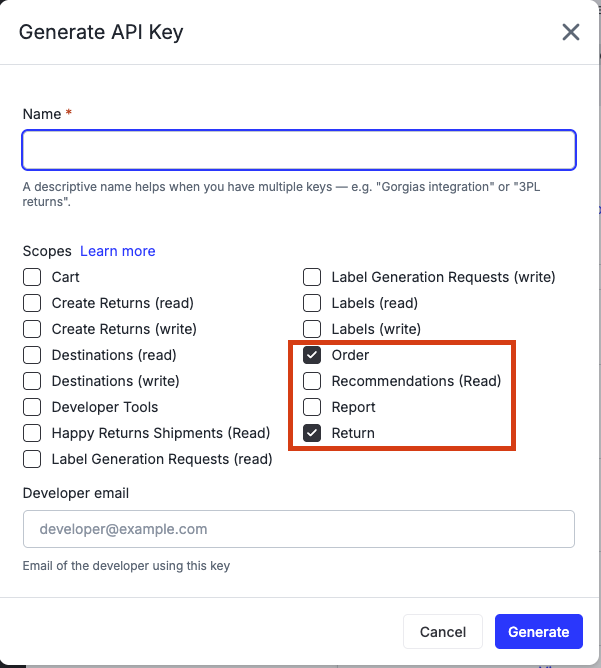
Select Order, Developer Tools, and Return as the scopes, then name the API key.
Step 2: Locate your Webhook Secret
ShipMonk uses your Webhook Secret to authenticate the events it receives from Loop.
In Developer tools, locate your Webhook Secret and copy it.
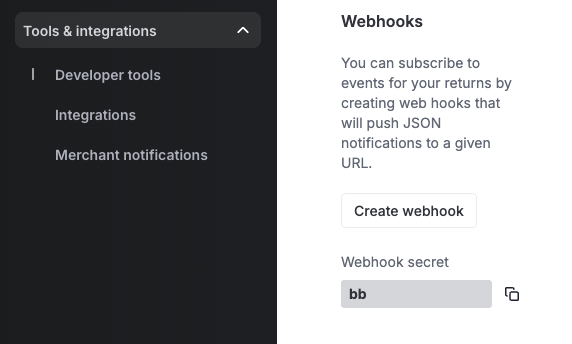
Note: If you can't locate your Webhook Secret, reach out to your Merchant Success Manager or support@loopreturns.com and they can point you to it.
Step 3: Send both credentials to ShipMonk
Send your API key and your Webhook Secret to ShipMonk. ShipMonk will register and activate the webhooks and finish configuring the integration on their end.
Important: Do not create the webhooks yourself in Loop. ShipMonk registers them automatically — manually creating webhooks with generic URLs will fail. Once ShipMonk confirms the setup is complete, the integration is ready to use.
Step 4: Set your processing events to Manual
To make sure returns in Loop aren't processed before the RMAs are processed in ShipMonk, set your processing events to Manual in Loop.
Important: With Manual processing, a return is only processed in Loop after ShipMonk processes the matching RMA, keeping the two systems aligned.
Troubleshooting
If returns are not being created in ShipMonk:
Confirm you've shared both your API key (Order + Return scope) and your Webhook Secret with ShipMonk, and that ShipMonk has confirmed the connection is set up on their end.
Check that the items in the order are mapped correctly (SKU to SKU).
If returns still aren't syncing, contact ShipMonk — because ShipMonk owns and maintains this integration (including the webhooks), they can confirm whether the events are being received and activated correctly.
Please reach out to support@loopreturns.com with any additional questions.