
Product Tags and Line Item Properties
OVERVIEW
Loop uses product tags and line item properties to manage return eligibility for specific items, including customized, personalized, and made-to-order products. You can use product tags and line item properties to mark items as Final Sale or Exchange Only, or use Workflows to build more flexible logic based on the line item properties you're already using.
Note: You can also use Workflows to configure product return outcomes in lieu of tagging.
Use the menu on the left to quickly navigate this article.
Product tags in the Loop admin
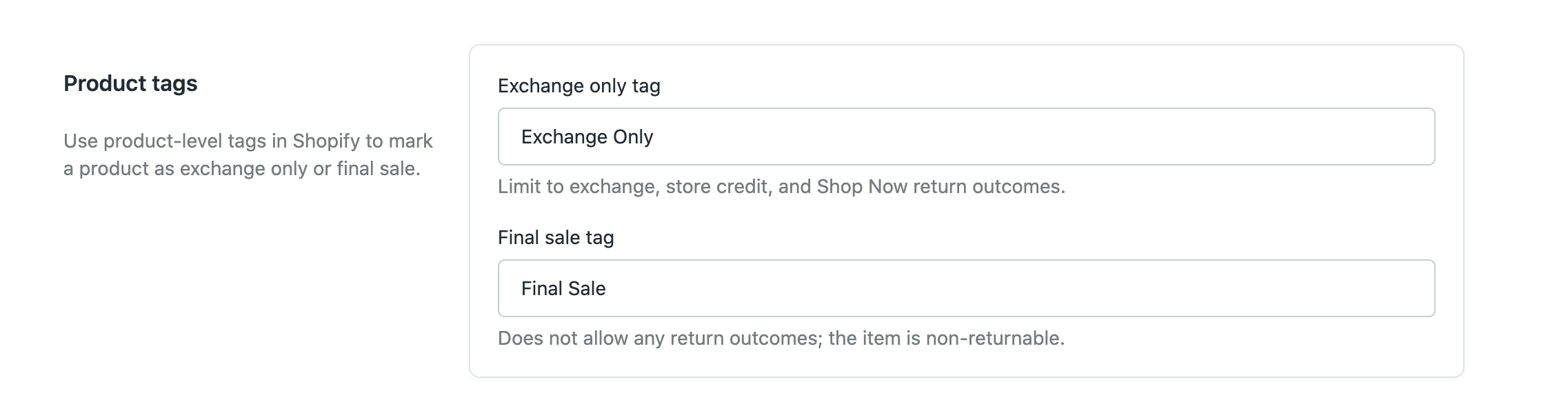
Under General Settings, the Final Sale and Exchange Only tags let you control which items are eligible to be returned in the Loop app.
To associate Shopify product tags with eligibility in Loop:
Go to Returns management > Policy settings > General > Product Tags.
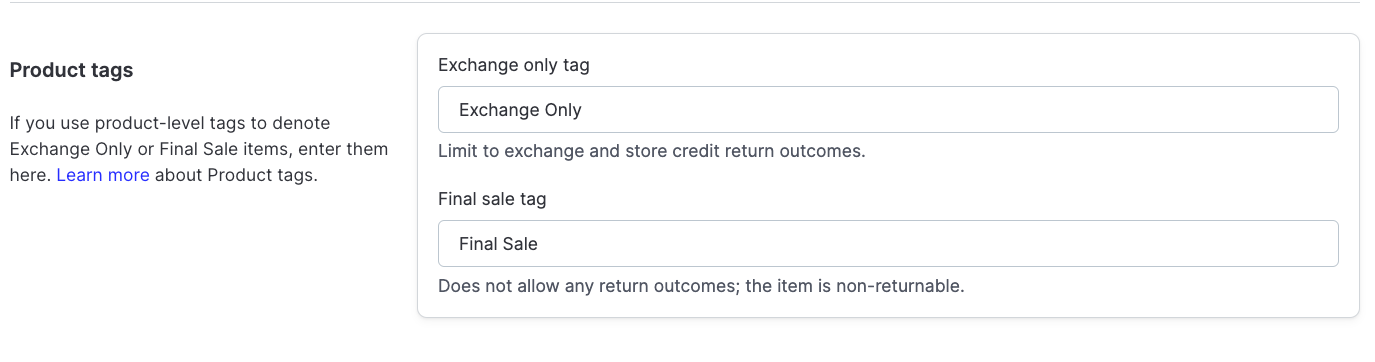
Enter the appropriate tags:
Exchange only tag: Products with this tag will be eligible for inline exchanges, refund to a gift card, exchanging for a new product (if you have Shop Now InApp or On-Store) and Advanced Exchanges.
Final sale tag: Products with this tag will be marked as ineligible for any return outcome.
Save changes.
Note: Any product tags that are in place at the time of the order will be honored, even if the tag is later removed from the product.
Using line item properties in Workflows
A workflow can be triggered by any line item property on a returned item, not just the legacy LPROP convention. This is the most flexible way to control how customized, personalized, or made-to-order products move through Loop.
If you already pass line item properties on your products to drive customization (engravings, gift notes, monograms, bundle markers, made-to-order values), you can use those same properties in Workflows without any additional dev work.
Tip: While the legacy LPROP convention outlined below is still supported, Loop recommends using the Workflows implementation for maximum flexibility without any additional dev work.
How the condition works
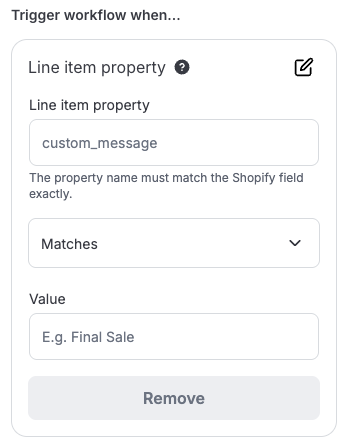
In any Workflow, add the Line item properties condition. You can:
Match on a specific value: e.g. property
engravingequalsgiftContains a string: e.g. property
note_to_recipientcontainsbirthdayCheck if the property exists: useful when the mere presence of a property (regardless of value) signals a customized item
You can combine the line item properties condition with any other Workflow conditions (product tag, variant, order value, etc.) for more targeted automation.
Common use cases
Jewelry and accessories: apply final sale to any item with an
engravingormonogrampropertyPersonalized apparel: route items with a
nameornumberproperty to a separate outcomeGifts and bundles: handle items with a
gift_messageorbundle_idproperty differently from standard line items
Important: Line item properties are evaluated at the moment the order was placed. If a property is added or modified after the order, Workflows will still evaluate against the original order data.
Using LPROP to manage line item properties
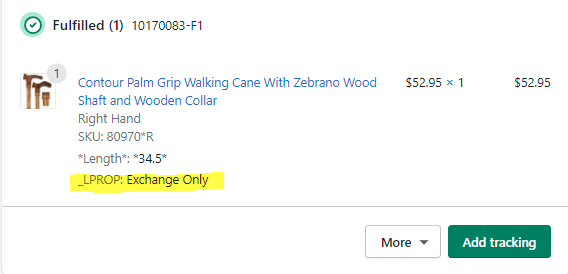
Line item properties use the LPROP name/value convention to apply Final Sale or Exchange Only at order time. This is the simplest path when those two outcomes are all you need, and you have the dev resources to add a new Loop specific line item property. For more flexible control - matching on any property key or value, or pairing line item properties with other conditions - see the Using line item properties in Workflows section above.
You can learn more about line Shopify Line Item Properties here. For Loop's purposes, following name/value pairs should be used:
Final Sale
Name: LPROP
Value: Final Sale (match value to string set in Loop Admin)
Note: If you'd like to hide the property name from the customer, Loop accommodates the Shopify underscore convention on the property name. (e.g. use name: _LPROP, value: Final Sale)
Exchange Only
Name: LPROP
Value: Exchange Only (match value to string set in Loop Admin)
Example product tag implementation
Tip: Line Item Properties are typically injected to make customized products non-returnable. Product customizations are often driven by Line Item Properties. If this is case, ask your Shopify Developer to add Loop's LPROP alongside these existing properties.
Important: The LPROP value will need to be inputted in the Product Tag fields in the General Settings in order for Loop to pick up on the line item properties.
FAQ
Do I still need to use the LPROP convention if I'm using Workflows? No. Workflows can read any line item property on the order. The LPROP convention is still supported for merchants already using it, but it is not recommended.
Are product tags case sensitive? No, product tags are not case sensitive. If the cases don't match in Shopify and Loop, but the word is still the same then the any rule associated with the product tag will still be recognized in Loop.
Please reach out to support@loopreturns.com with any additional questions.