
User Accounts
OVERVIEW
This article explains how to manage user accounts and permissions within the Loop admin. It covers the process for adding, editing, and deleting staff accounts, as well as the different user roles available in Loop, and the specific permissions granted to each role.
Use the menu on the left to quickly navigate this article.
Managing Users
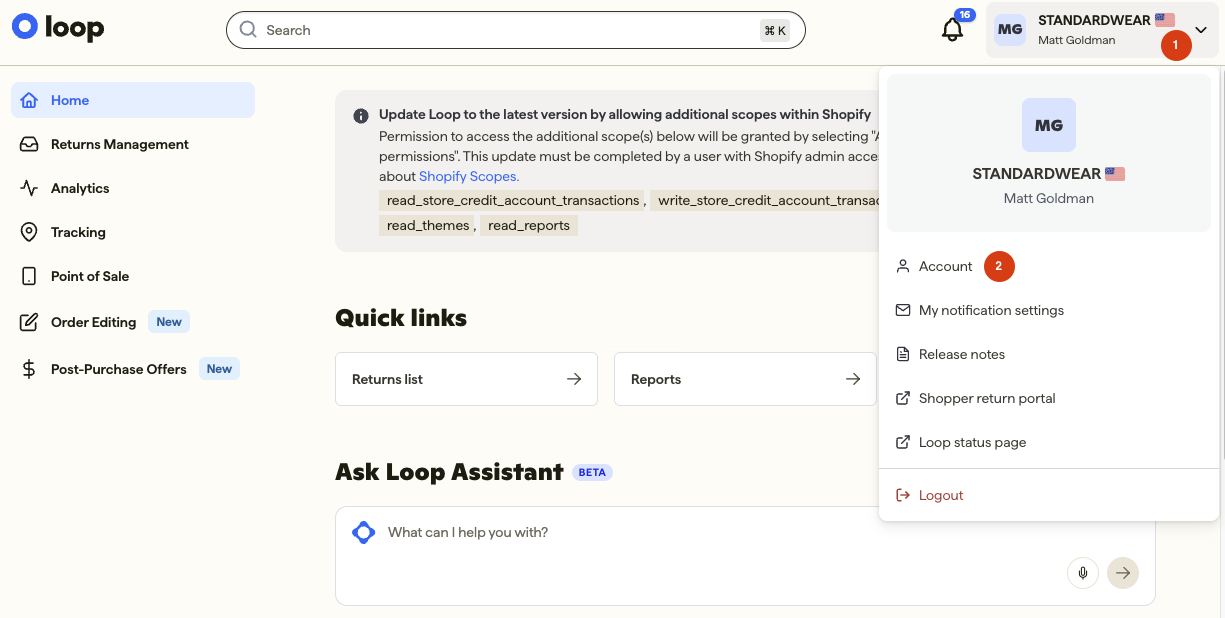
To access Accounts, go to the Loop admin, click on the user in the upper right corner, then click Account.
Add an account
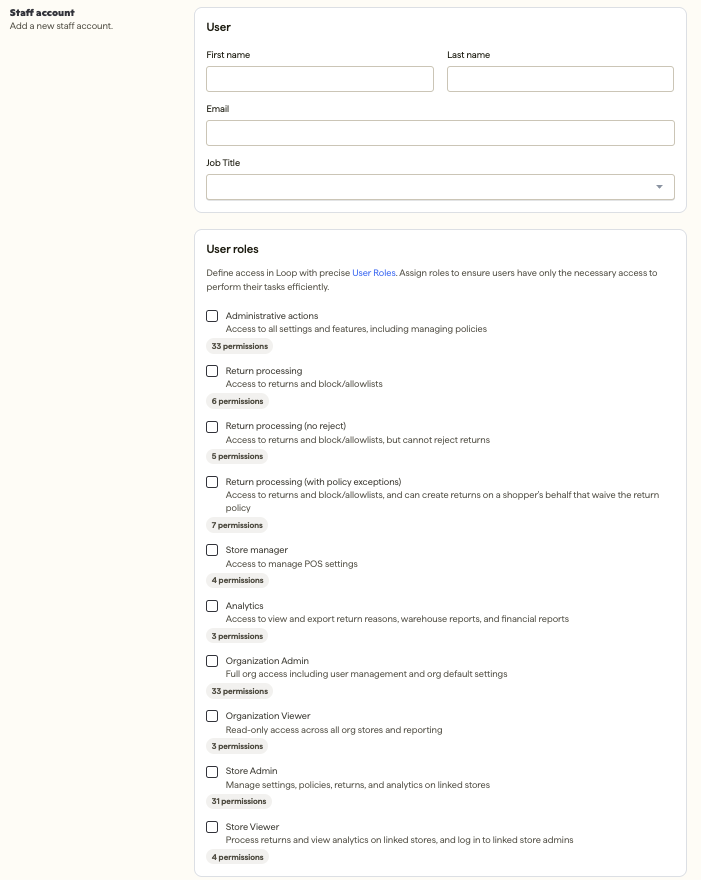
Select Add staff account.
Fill out the required fields.
Check the appropriate User Roles. For more details, refer to User Roles below.
Save changes.
New user will then receive an invitation to their email to sign up.
Edit an account
Click on an account name.
Change the information in the appropriate fields.
Save changes.
Delete an account
Click on an account name.
Select Delete.
Note: Staff Accounts do not have the ability to delete the Account Owner.
User Roles
Account Permissions allows you to limit an account's access within the Loop admin to sections related to their role and limits unnecessary exposure of sensitive information and functionality. Each Loop instance has one designated Account Owner and can add as many Staff Accounts as needed.
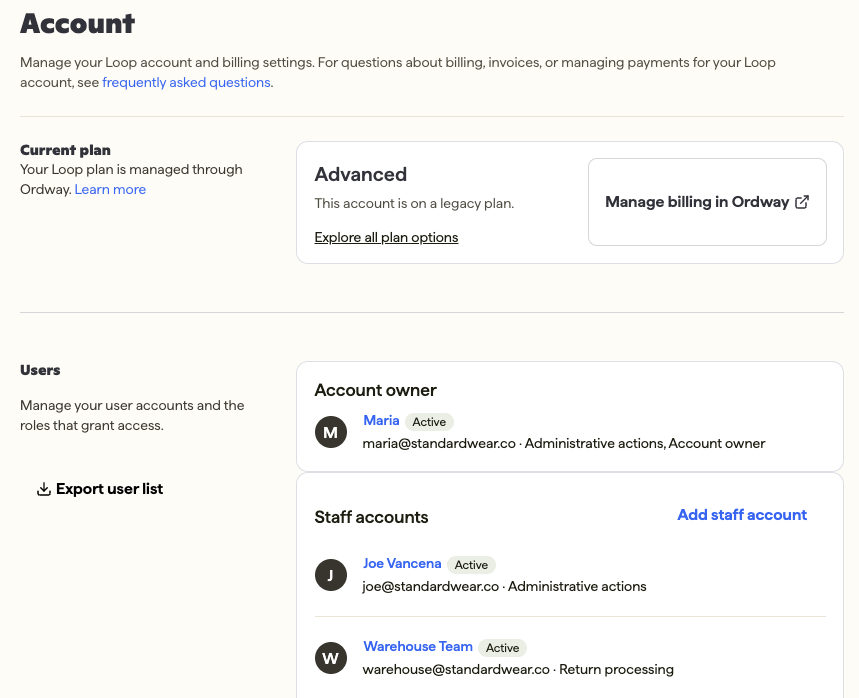
Account owner
The Account Owner is:
Assigned to the first account created in your Loop admin during the onboarding process
The main point of contact for Loop regarding details on feature releases, beta access to features and product feedback
Granted full access to the Loop admin
Staff Accounts cannot change the Account Owner's information
Note: If you want to change the Account Owner, contact Loop Support.
User roles
Loop has ten user roles, each granting a different level of access:
Administrative actions — Access to all settings and features, including managing policies: all 33 permissions (see the full list below). This is the only store-level role with access to Developer tools; the sole restriction is being unable to edit the Account Owner.
Return processing — Access to returns and block/allowlists: Manage returns, List returns, Manage listings, Manage instant exchanges, View users, Reject returns.
Return processing (no reject) — Access to returns and block/allowlists, but cannot reject returns: Manage returns, List returns, Manage listings, Manage instant exchanges, View users.
Return processing (with policy exceptions) — Everything in Return processing, plus the ability to create returns that are exceptions to your return policy: Manage returns, List returns, Manage listings, Manage instant exchanges, View users, Reject returns, Create exception returns.
Store manager — Access to manage POS settings: Manage locations, Manage listings, List returns, Manage point of sale. This role exists specifically for brick-and-mortar store managers who need Loop access strictly to manage POS returns.
Analytics — Access to view and export return reasons, warehouse reports, and financial reports: Manage reporting, View analytics, View users.
Organization Admin — Full access across every store in a multi-store organization using Loop Store Manager, including user management and organization default settings: all 33 permissions.
Organization Viewer — Read-only access across all stores in a multi-store organization, plus reporting: List returns, View analytics, View users.
Store Admin — Manages settings, policies, returns, and analytics on stores linked to a multi-store organization, without the ability to manage that store's users: all 33 permissions except View users and Manage users (31 total).
Store Viewer — Processes returns and views analytics on linked stores, and can log in to linked store admins: List returns, View analytics, Manage returns, Reject returns.
Note: Staff Accounts can have a combination of Return processing, Analytics, and Store manager at the same time. Analytics includes access to the warehouse (ASN) report, which may be useful when needing an update on open returns.
Note: Organization Admin, Organization Viewer, Store Admin, and Store Viewer are only available to multi-store organizations using Loop Store Manager to administer multiple stores from a single login.
Full list of permissions
Loop has 33 permissions in total:
Manage returns, Manage reporting, Manage listings, View analytics, Manage policy rules, Manage shop now, Manage advanced exchanges, Manage general settings, Manage return policies, Manage destinations, Manage notifications, Manage reasons, Manage customizations, View users, Manage users, Manage developer tools, Manage scopes, Manage shipping services, Manage custom features, Manage bundles, Manage integrations, Manage workflows, Manage point of sale, Manage tracking, Manage warranty policies, Manage instant exchanges, Manage fulfillable locations, Manage labels, List returns, Manage locations, Submit activation codes, Reject returns, Create exception returns.
FAQ
Is there a limit to the number of user accounts I can have for my Loop instance? Nope! While you can only have one Account owner, you can have endless Staff Accounts.
Why can't I log in to my other shop using the Switch Shops option? If your account is connected to multiple Loop instances, you won't be able to switch between connected shops until you've accepted the email invitation to the new shop. See the Multi-Shop Login help center article for details.
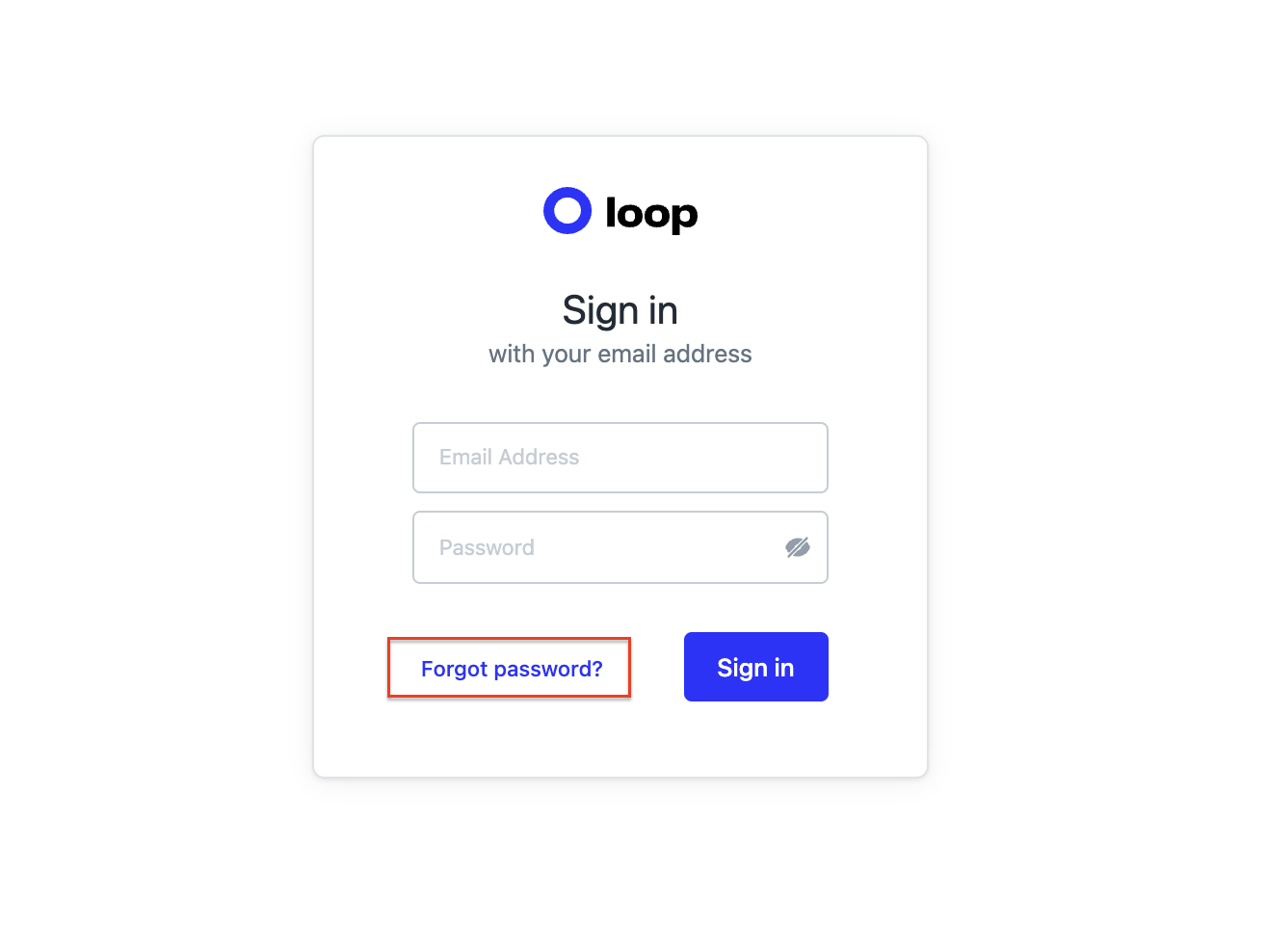
I forgot my password. How do I reset? To reset your password, select "Forgot Password?" at the login screen in the Loop admin.
What's the difference between a store-level role and an organization-level role? Store-level roles (like Administrative actions or Return processing) apply to a single Loop store account. Organization-level roles (Organization Admin, Organization Viewer, Store Admin, Store Viewer) are only available to multi-store organizations using Loop Store Manager, and grant access across every store in the organization from one login.
Please reach out to support@loopreturns.com with any additional questions.